Pages

Thursday, December 12, 2013

Why Britain Has Bond and America Has Bourne

In the wake of disturbing revelations from Wikileaks and NSA whistleblower Edward Snowden about widespread government spying, the British public appeared to be unruffled by a controversy that sparked heated debate in the United States. Guardian columnist Jonathan Freedland says “Americans are outraged to discover they are being spied on and watched. Britons give a kind of polite shrug of the shoulders and say, ‘So what?’” What accounts for this disparity of attitudes? Apparently the answer is Bond. James Bond.

To begin with, a recent article at Public Radio International argued, the British are already much more accustomed than Americans to living under perpetual government surveillance. Nick Pickles (can that really be his name?) of Big Brother Watch estimates there are as many as four million surveillance cameras focusing their unblinking eyes on a country of just over 60 million people.

Freedland points out an even bigger difference between the two countries: unlike American populists, British society “still bears the imprint of its monarchical origins,” which means that power flows from the government to the people, not the other way around. Britons, he says, are “subjects rather than citizens,” more inclined to submit to being spied upon than Americans, who tend to strongly resent government invasion of privacy.

Also unlike Americans, the British by and large inherently trust their government and its spy agencies. Why? Curiously, research shows that secret agent icon 007, fictional though he may be, has deeply influenced that perception.

James Bond is an unabashed patriot, essentially a civil servant (albeit one with a license to kill) putting his life on the line on behalf of Queen and Country. He trusts his government support team implicitly, from gadget master “Q” all the way up to his superior “M.”

At one point in the most recent Bond blockbuster movie Skyfall, for example, Bond is a captive of the creepy Silva, once an agent like Bond but who has turned on his former masters. “Just look at you,” Silva muses about Bond, who is recovering from a gunshot wound. “Barely held together by your pills and your drink –”

“Don’t forget my pathetic love of country,” Bond finishes for him.

“You’re still clinging to your faith in that old woman,” says Silva, referring to the unwavering patriot M, who keeps on her desk a Union Jacked ceramic bulldog, symbol of British fighting determination. That trust in government authority has influenced British audiences over the decades since Ian Fleming introduced Bond in the 1950s.

Now contrast Bond with his American movie counterpart Jason Bourne, portrayed by Matt Damon (in The Bourne Legacy, the latest installment, Jeremy Renner takes over the lead from Damon, but as a different character). The distinction between Britons’ and Americans’ worldviews quickly becomes apparent.


Wednesday, December 11, 2013

Last Regrets of the Dying

As we enter the holiday season and approach a New Year, it’s important to get our perspective straight on what is truly meaningful – before it’s too late.

Recently the Huffington Post reposted an article that has made the rounds of the internet for a couple of years, “The Top 5 Regrets of the Dying.An Australian nurse named Bronnie Ware spent years assisting seriously ill patients in the last few weeks of their lives, and compiled their most common regrets in a blog post that went viral, then into a book of the same title. Below is that list and some of her comments, as well as thoughts of my own.

1) I wish I’d had the courage to live a life true to myself, not the life others expected of me.

The most common regret of all. Ware: “When people realize that their life is almost over and look back clearly on it, it is easy to see how many dreams have gone unfulfilled… due to choices they had made, or not made.”

Most of us live in blissful denial of our own mortality until it’s staring us in the face. Especially when we’re young, life stretches before us seemingly without end, and we assume we have both world enough and time. And then suddenly, our time is up, many of our dreams lie half-finished or not even begun, and we wish we’d lived our lives more fully.

But it’s important to cut ourselves some slack and realize that we’re all fallibly human and our time is finite. Not all of our dreams were meant to be, regardless of our choices. When we enter some doors, others close, and life throws us all unexpected curveballs – sometimes real game-changers.

2) I wish I hadn’t worked so hard.

This is primarily, but no longer exclusively, a male regret. Every male patient that Ware nursed “deeply regretted spending so much of their lives on the treadmill of a work existence. They missed their children’s youth and their partner’s companionship.”

This is perfectly understandable – on our deathbed, who wouldn’t look back and wish we’d spent less time at the office and more time enjoying life with our loved ones? But it’s unrealistic as well – unless we’ve inherited a fortune, working hard is what enables us to afford to have those families in the first place, to provide for them and take them to Disneyland now and then. We have to do what we have to do. But granted, it’s important to calibrate our priorities and find the best balance.

3) I wish I’d had the courage to express my feelings.

“Many people suppressed their feelings in order to keep peace with others. As a result, they settled for a mediocre existence and never became who they were truly capable of becoming.”

I suspect this is less of a problem for younger generations than for Ms. Ware’s aged patients, since we live in an age in which outspokenness to the point of offense is encouraged. But it’s true that suppressing your feelings leads to the twin cancers of bitterness and regret.

Monday, December 9, 2013

It’s Go Time for Van Damme

Jean-Claude Van Damme is back.

His heyday of the 90s far behind him, the former “Muscles from Brussels,” Bloodsport kickboxer, and mulleted action star with the odd forehead lump recently began popping up in GoDaddy commercials, beating bongos and shaking maracas while doing the splits, leering at small business owners and yet inspiring them with a husky “It’s go time.” At the American Film Market trade show last week, his not-yet-released action flick Swelter scored pretty big, selling in multiple territories around the world. But what has really propelled him back into the public eye is his extraordinary, commanding appearance in an epic new Volvo commercial.

Unlike the whimsical, frenetic GoDaddy ads, the Volvo spot has a tranquil, ethereal beauty about it. It features Van Damme staring impassively at the camera with the focus of a Zen master, while the two semis beneath his feat carry him backwards, ever so carefully and precisely diverging – in reverse – until his split legs are parallel to the highway streaming underneath. Not bad for a 53-year-old. Van Damme and the trucks continue into the sunrise to the accompaniment of Enya’s lush “Only Time.” Meanwhile his voiceover proclaims in his famous accent, “I’ve had my ups and downs, my fair share of bumpy roads and heavy winds.” Indeed he has. “That’s what made me what I am today.”

What he is today is a survivor – of poverty, bipolar disorder, drug addiction, and fame – and one of Hollywood’s most unique personalities. Obsessed with stardom, the young martial artist hit Los Angeles in 1982 and struggled through a period of homelessness looking for his big break, which came six long years later in Bloodsport. The superfit actor was at the top through the early 90s until his films gradually declined at the box office, and Van Damme himself declined emotionally and physically. At one point he was blowing through $10,000 a week on cocaine.

“It became a point where I wanted to die. I didn't have any reasons to live,” he confessed. “Then you have to find back your self-esteem. And then, slowly, every piece of yourself becomes precious again... It’s not the drugs. It’s a problem with yourself, which you have to cure.”

And so Van Damme worked his way back to personal and professional respect. For those who don’t take him seriously as an actor, check out his stunning turn in JCVD from 2008, in which he plays himself as a down-on-his-luck actor: broke, unable to get work, embroiled in a custody battle for his daughter, and suddenly at the center of a hostage situation in his hometown Brussels.

At one point in this underappreciated drama, Van Damme and the camera rise above the set, and he addresses the viewer directly in a riveting, emotional, six-minute monologue* in which he rambles about his fame, numerous marriages (five times to four different women), and drug abuse. It is nakedly personal, compelling, and honest, and it garnered him newfound and hard-earned respect. Time rated his performance the second best of the year, after Heath Ledger’s unforgettable Joker in The Dark Knight. Not bad for a down-and-out former action star everyone had written off.

Tuesday, December 3, 2013

Stop Calling Superheroes Fascist

My good friend Chris Yogerst has a quick but interesting read in The Atlantic with the above title. An excerpt:
Indeed, superhero tales are full of subplots about how heroes limit their own power: hibernating once the big bad guy has been defeated, wearing disguises to live ordinary lives, choosing not to give into the temptation to ally with the villain or use their powers for profit or even civilizational progress. That’s because the creators of some of the most foundational superhero tales weren’t writing solely out of a power fantasy. They were writing out of a fantasy that a truly good people who find themselves with power might use that power only for good—and only in the face of extreme evil.
Read it all here.

A Walk on The Dark Side with Kira Davis

Had a fun and interesting chat tonight about actor Paul Walker and pop culture with my friend Kira Davis, on her show The Dark Side. She's very good - check her out. We may do a year-end entertainment wrap-up soon....

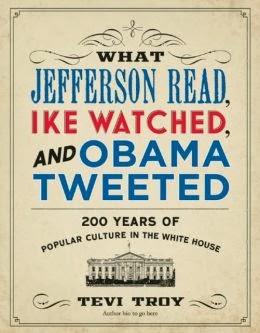
What Jefferson Read, Ike Watched, and Obama Tweeted

Though we might think that the President of the United States should have the gravitas and proper sense of priorities to operate above the triviality of the entertainment biz, Barack Obama has won two elections in no small measure because of his shrewd understanding of, and engagement with, pop culture. He chats on late night talk shows, hangs with today’s biggest recording artists, and jets out to Hollywood periodically for fundraisers – it’s a wonder he has time for all the golfing required of the Leader of the Free World. But he’s not the first president to exploit that arena – only the savviest.

In the recent book What Jefferson Read, Ike Watched, and Obama Tweeted: 200 Years of Popular Culture in the White House, Tevi Troy examines how presidents have interacted with pop culture from our nation’s beginning to today. Why should this matter? Because “how a president engages popular culture,” Troy writes, “tells us about the people who elected him, the changing nature of American politics and society, and the tension between high-, low- and middle-brow pursuits.” The book “is an exploration of how presidents have made use of a multiplicity of cultural pursuits… and how those pursuits have in turn shaped them and the nation.”

The Founding Fathers, for example, were extraordinary bibliophiles even in a time when reading was already a widespread pursuit, at least in the upper classes. “I cannot live without books,” Jefferson said, and John Adams’ library exceeded even his. They weren’t just indulging in beach reads, however; they were soaking up philosophy and Enlightenment ideas that helped them shape the American Experiment.

Besides books, the Founders also eventually acquired an appreciation for theater, the primary form of non-reading entertainment at the time, and not the highbrow pursuit it is today. Our early presidents used this common appreciation for the theater to connect with the people. Tyler, for example, “could quote Othello in a political speech because even his most simply educated countrymen were taught Shakespeare and because so many people went to the theater.”

Andrew Jackson, on the other hand, was badly educated and poorly-read, but connected easily with the common people; after him, “presidents wouldn’t have to be well-read or well-educated, but they would need to have the common touch.” And that touch depended heavily on presidents’ connection – or lack thereof – with popular culture.

It is a commonplace now that American pop culture, for better or worse, has become the world’s pop culture, but until the mid-19th century America wasn’t even considered to have a culture. In 1820 a European writer observed, “In the four quarters of the globe, who reads an American book?” But President McKinley’s childhood affinity for the Atlantic Monthly indicated the rising importance of a literary American culture. By the end of the 19th century, there would be no one in Europe who didn’t read American books. Uncle Tom’s Cabin, the bestselling novel of the century and second overall only to the Bible, broke down those international barriers.

What We Lost When We Lost Paul Walker

The entertainment world was stunned Saturday evening to learn of the untimely death of actor Paul Walker, only 40 years old, of the phenomenally successful Fast and Furious movie franchise. Ironically, the car enthusiast Walker and his racer friend Roger Rodas both perished when the red Porsche Carrera GT Rodas was driving lost control on a Southern California road, struck a tree, and burst into flames.

In response to the outpouring of shock and sadness from fans, Erin Gloria Ryan, news editor at Jezebel, thought she was making an insightful point about celebrity worship when she cynically tweeted, “None of you really love Paul Walker. You just love the IDEA of Paul Walker.” She is very wrong about that.

First of all, while I’m as critical as anyone of our sometimes irrational relationship with the famous, people often forget that celebrities are human beings too. Many of them are horrible human beings, it’s true, and that’s often how they got to be celebrities in the first place – not merely because they are talented but because they are almost maniacally self-centered as well, as opposed to talents who don’t have that obsessive drive to “make it” no matter how many little people they crush underfoot along the way.

Not all celebrities are monsters or mere carefully constructed media images. By all accounts, everyone who knew and worked with Paul Walker (including personal friends of mine) declare him to be a decent, good-hearted guy unaffected by the warping seduction of fame and fortune. He never misbehaved in the tabloids or starred in his own reality show train wreck. On his IMDb page, Walker is quoted as saying,

Some people say that you should go to all the parties, to the nightclubs, the Viper Room, and make contacts, and I look at them and say, “You don't want to have contacts with those people.” Look at what happened to River Phoenix [who died in 1993 of a drug overdose outside the Viper Room]. If you get caught up in that, it ruins you. Hollywood is garbage.

When entertainment figures die, studios typically release a standard, glowing official statement, but I believe Universal (the Fast and Furious studio) is not exaggerating when they say, “Paul was truly one of the most beloved and respected members of our studio family for 14 years.”

UCLA Accused of Racial “Micro-Aggression”

About 25 graduate students “of color” staged a sit-in in professor Val Rust’s UCLA classroom recently, alleging that there is a “toxic” racial climate in the Graduate School of Education & Information Studies. As partial evidence of that poisonous climate, they complained that the grammar and spelling corrections he made on their dissertation proposals are a form of racial “micro-aggression.”

The demonstration stemmed from a new report stating that UCLA’s policies and procedures don’t sufficiently address racial discrimination among the university’s faculty. The organizers alleged several examples, unspecified in the Daily Bruin article, in which minority students faced challenges and “micro-aggressions” from professors. Nora Cisneros, one of the sit-in participants, said they chose to protest Rust’s class because he doesn’t encourage “a climate where students of color can discuss issues of race openly.”

This seems a curious accusation, since one of his areas of teaching expertise is “ethnic issues in international perspective.” Several of Rust’s current and former students said they thought it was unfair to target him, because he is a supporter of intercultural learning, whatever that is, and that he was being used “as a scapegoat for much larger issues.” Grad student Emily Le said, “It is disturbing that students would make such unfounded accusations based on misperceptions of what they believe as racism.” Disturbing perhaps, but unsurprising considering that racism today exists wherever it suits anyone to see it.

Rust himself believes that the demonstrators have legitimate concerns and that the department should organize a town hall meeting “to begin a dialogue.” Perhaps that dialogue could begin by addressing why graduate students at a major university – in the Department of Education and Information Studies, remember – need to have their grammar and spelling corrected, and why that correction constitutes racism. Rust said, “I have attempted to be rather thorough on the papers and am particularly concerned that they do a good job with their bibliographies and citations, and these students apparently don’t feel that is appropriate.” They don’t feel it’s “appropriate” because they are exploiting their self-designated victim status as an excuse to avoid being held to the department’s stated high academic standard.

In case you’ve been blissfully ignorant until now of this term “micro-aggression,” the UCLA report defines it as “subtle verbal and nonverbal insults directed toward non-whites, often done automatically and unconsciously. They are layered insults based on one’s race, gender, class, sexuality, language, immigration status, phenotype, accent, or surname.” It was coined in 1970 by a psychiatrist to describe acts of racism so subtle that neither the “perpetrator” nor the “victim” is even fully conscious of what is happening. “The invisibility of racial microaggressions may be more harmful to people of color than hate crimes or the overt and deliberate acts of White supremacists such as the Klan and Skinheads,” writes Dr. Derald Wing Sue, author of the influential Racial Microaggressions in Everyday Life: Race, Gender and Sexual Orientation.

So, unconscious racism that goes unnoticed by both parties is more of a danger than actual lynching – got that? (If you want to see to what ludicrous degree this phantom threat can be carried, check out this McGill University op-ed  by the school paper’s Health and Education editor, Ralph Haddad. He accuses “Movember,” the annual month-long campaign in which men raise awareness of, and funds for, men’s health issues by growing mustaches, of “racist, sexist, and transphobic” micro-aggression.)

Apparently such micro-aggression is a greater concern among the race-obsessed left than the macro-aggression of, say, the “knockout game,” currently a trend among roving gangs of black youth who target random, unsuspecting whites or Jews with sometimes murderous violence. But never mind that; the outrage of these racist spelling corrections must be addressed.

Monday, December 2, 2013

The Death of Creativity

To look at the shelves of bookstores these days (if any still exist in your neighborhood), one might think that this is a time in which creativity is hot. Titles about creativity – explaining it, unleashing it, using it to galvanize artistic fulfillment and business success – abound. But is this trend evidence that we are living in an age of unprecedented innovation? Is any meaningful, transformative creativity actually taking place, or is it all just hype and buzzphrases like “thinking outside the box”?

Amid this celebration of creativity, it’s easy to forget that for most of history, creativity has been resisted, not encouraged. In past eras people clung to received wisdom and tended initially to reject, often violently, new concepts and creative leaps forward, not embrace them. Christ, as an obvious example, was crucified for ideas that threatened the reigning political and religious authorities of the time; I hardly need to point out what a far-reaching impact those ideas went on to have. Galileo’s sun-centered astronomical views earned him censorship and imprisonment from the Church Inquisition in his own day; but he is now considered by many to be the father of modern astronomy. When the Impressionists dared to debut their (at that time) startling vision at an 1874 Paris exhibition, they were universally reviled and ridiculed by critics and the public alike; today the movement is considered the genesis of modern art.

Visionary creativity – disorienting breakthroughs like the ones above – is generated by outsiders, rebels, bold individuals who dare to turn conventional wisdom on its head and face the consequences. Creation is a radical act, and society can handle only so much “shock of the new,” as art critic Robert Hughes titled his excellent 1980 documentary series. So rebels very often pay a steep price for their daring.

But the new literature of creativity seems to be less about rebellion than convention. Salon recently reposted a Harper’s magazine article by Thomas Frank which examined the popularity of books about creativity. The more books about it Frank read, the more conventional and repetitive and, well, uncreative they all sounded, until he realized that the genre was less about creativity than “superstition, in which everything always worked out and the good guys always triumphed and the right inventions always came along in the nick of time”:

What determines “creativity,” in other words, is the very faction it’s supposedly rebelling against: established expertise… [F]or all its reverential talk about the rebel and the box breaker, society had no interest in new ideas at all unless they reinforced favorite theories or could be monetized in some obvious way.

Where creativity used to be the domain of the genius, the seer, the artist, the inventor, Frank claims that the new “creativity promoting sector” targets “the professional-managerial audience itself, whose members… think they’re in the presence of something profound when they watch some billionaire give a TED talk. And what this complacent literature purrs into their ears is that creativity is their property, their competitive advantage, their class virtue.”

Wednesday, November 27, 2013

What’s Behind Upworthy’s Success? The Answer Will Make You Cry

As if the internet weren’t already such an infinite time suck, along comes a website that targets curious, ADD-addled procrastinators such as myself with blatant but ridiculously effective “click-bait.” Once you’re hooked, its content tugs at your heartstrings so irresistibly that you may not even realize you’re getting a dose of a social message as well.

Upworthy is a phenomenally successful site that scans the internet for “things that matter,” as its motto goes, and then propels them into the pageview stratosphere. Launched in March 2012 by Eli Pariser, former executive director of the activist site MoveOn, and Peter Koechley, former managing editor of the satirical news site The Onion, Upworthy was described in a recent Fast Company article as “the fastest growing media site of all time.” It lured 25 million unique visitors in the first week of this November alone.

What accounts for this skyrocketing growth? Upworthy has mastered the art of marketing “click-bait with a conscience,” as The Atlantic put it recently. A slideshow of Upworthy’s strategy explains that the simple idea is to pique readers’ curiosity with a headline tease that compels them to click, and content that compels them to share. “If you can find that happy medium between entertainment and an emotional connection,” reads one slide, “you can make some magic happen.” Hence an example like, “The Things This 4-Year-Old Is Doing Are Cute. The Reason He’s Doing Them is Heartbreaking.”

Here are some other examples that might be familiar to you, from a list of Upworthy’s 11 greatest hits, along with their traffic numbers: “This Kid Just Died. What He Left Behind is Wondtacular” (17 million pageviews); “9 out of 10 Americans Are Completely Wrong About this Mind-Blowing Fact” (6.3 million); “His First 4 Sentences Are Interesting. The 5th Blew My Mind. And Made Me A Little Sick.” (4.9 million).