
Monday, July 18, 2016
Mark on National Review Online and the Rod Arquette Show

Friday, July 15, 2016
Is There a Right Way to be a Boy?

The Huffington Post recently posted a photo
series from a project called #ABoyCanToo, portraits of boys who pursue interests
traditionally associated with girls. The article, titled, “13 Empowering Photos Show There’s No Right
Way to Be a Boy,” praises
the project for “shining a light on kids who don’t let gender norms prevent
them from following their dreams.”
The photographer behind the collection, Canadian
mom Kirsten McGoey, told HuffPost that she drew inspiration from her own three sons, especially
the 8-year-old middle child, whose favorite activities are singing, acting,
ballet and tap-dancing. “He loves sparkles, pink, rainbows, reading, and has
never been concerned if something was ‘boy’ or ‘girl,’” she gushes.
McGoey has photographed 17 boys, her own among
them, whose passions range from baking to reading books to dancing onstage to
wearing hoop skirts. “Our little boy loves to do his hair with all sorts of
hair accessories,” reads a proud parent’s caption under one of the photos. “He
was born to dance and take flight,” reads another. “Our stage loving boy…
simply lights up when the lights go down and the spotlights turn on,” says a
third. The lesson McGoey has learned
from her photo subjects, the message she wants to convey, is that their
interests may be unconventional but they enable the boys to feel they are
talented at something and are valued.
There’s absolutely nothing wrong with this,
and there is no need for traditionally-minded parents like myself to freak out.
Young children are curious and should be encouraged to explore what interests
them – that’s how they learn best – even if that interest ultimately fizzles
out, as it often does. Sometimes what seems to be a kid’s passion ends up
simply being a phase. When I was six I wanted to grow up to be, simultaneously,
an astronomer and an archaeologist; needless to say, neither pursuit went
anywhere, for which I’m relieved. My 6-year-old daughter used to be a tomboy
and wanted to be the first female winner of American
Ninja Warrior, and I
encouraged that interest. Now she’s very feminine and wants to be,
simultaneously, an architect and a doctor, and I’m encouraging those passions
as well; but that doesn’t mean she is destined to become either one (although
perhaps she is; time will tell).
The War on Cops

There is no more
important book to read right now than Heather Mac Donald’s clear-eyed, riveting
new work The War on Cops: How the New Attack on Law
and Order Makes Everyone Less Safe. You cannot fully get to the core of the
truth about the current anti-cop sentiment in the country, or be armed with the
facts to shoot down Black Lives Matter lies without reading it. If you can get
a copy, that is – demand is so great that there is currently a one-to-two month
wait for it on Amazon.com. Don’t wait – get the ebook.
In case you
haven’t already been following everything Mac Donald writes, she is the Thomas
W. Smith Fellow at the Manhattan Institute and a contributing editor of City
Journal. Her writings have appeared in the Wall Street Journal,
Washington Post, New York Times, The New Republic, Partisan Review, The New
Criterion, and elsewhere.
She is the
recipient of the New Jersey State Law Enforcement Officers Association’s 2004
Civilian Valor Award, the 2008 Integrity in Journalism award from the New York
State Shields, the 2008 Eugene Katz Award for Excellence in the Coverage of
Immigration from the Center for Immigration Studies, and the 2012 Quill &
Badge Award for Excellence in Communication from the International Union of
Police Associations. In other words, unlike the legion of talking heads in the
news media pontificating about the racism in American law enforcement, Heather
Mac Donald has actually done the journalistic legwork, is qualified to discuss
the subject, and is bold enough to speak the truth about it.
The War on Cops begins by noting
that crime is skyrocketing in cities across the United States as “the most
anti-law-enforcement administration in memory draws to a close.” This isn’t,
however, “the greatest danger in today’s war on cops. The greatest danger lies,
rather, in the delegitimization of law and order itself.” If we don’t begin to
counter the present lies about law enforcement propagated by the Black Lives
Matter movement and facilitated by a complicit media and by the “academic
victimology industry,” Mac Donald concludes, civilized urban life will break
down – which we are already beginning to witness.
Ms. Mac Donald
took time out to answer a few questions about crime, terrorism, and the recent
Dallas cop shooting for FrontPage Mag.
Tim McGraw’s ‘Humble and Kind’ Movement

I’m not especially a fan of country music, although I do respect the genre
for being song-oriented, for telling stories about real human emotions, and for
featuring performers who can actually play, sing, and write – all of which is too
often absent from the sampled beats and profane braggadocio that pass for music
and lyrics in contemporary Top 40. So it took a friend to introduce me to a touching
song performed by superstar Tim McGraw that not only was a number one hit this
year, but that is inspiring a groundswell of unusual activism among its fans.
The single “Humble and Kind,” written by singer/songwriter Lori McKenna, was
released on January 20 off McGraw's album Damn Country Music and went on
to reach number one on the country music charts in both the United States and Canada.
The song’s video, featuring affecting imagery from Oprah Winfrey’s documentary Belief, won “Video of the Year” at the
2016 CMT Music Awards.
In the lyrics, McGraw offers some parental life advice to a child departing
for college – and in fact, his own daughter Gracie, who recently journeyed off
to school herself, was in the forefront of his mind when he recorded the song. The
sentiment was genuine. “I cried through every take,” he admitted. “It certainly is a letter to your kids in a lot of ways.” McKenna, too,
said she had her own five children in mind when she wrote it.
Sunday, July 10, 2016
Wednesday Morning Club: Heather Mac Donald

I'm honored to introduce Ms. Mac Donald at the event, which will be held at the Four Seasons in Beverly Hills. For more information, click here.
Thursday, July 7, 2016
Does Character Matter Anymore in Politics?

The 2016
presidential election seems headed toward a showdown between the two least-liked
presidential candidates since American voters have been polled on the
question – and with good reason. One is a vindictive, politically ruthless, unrepentant
liar; the other is an egomaniacal, boorish, bullying braggart. Neither one even
bothers to pay lip service to the values of honesty, integrity, humility, and
moral courage, and yet somehow this distasteful duo has emerged from the campaign
battle royal as the presumptive party nominees.
What does this say
about personal character in American politics today? Does character in politics
matter any longer, or are principles now just hindrances to winning elections? After
Nixon and Watergate, and certainly after the scandals of Hillary Clinton’s
husband Bill in the 1990s, are we cynically resigned to a political culture
that dismisses moral exemplars as suckers and losers instead of role models and
leaders?
This isn’t an
entirely new development. History is littered with examples of leaders of
dubious character or worse. Many people enter the political arena with a genuine
commitment to civil service or a passion to change the world, but politics has always
attracted a disproportionate share of scoundrels with a bottomless lust for
power and self-aggrandizement. The difference is that now we seem to be
accepting, if not actually embracing, the latter.
Sunday, June 26, 2016
The Antidote to Toxic Masculinity

The recent slaughter of nearly 50 people in an Orlando gay bar is now the
deadliest mass shooting in American history, and as such it has ratcheted up
our national conversation about guns and terrorism into a frenzied crosstalk
about whom and what to blame: Islam? The NRA? Homophobia? Salon’s Amanda Marcotte believes it can all be explained by “toxic
masculinity.”
Toxic masculinity is a concept from the men’s movement that feminists like
Marcotte have pounced on to explain the root cause of all violent male
misbehavior from gay-bashing to domestic violence to terrorism. “It is a
specific model of manhood,” she writes, “geared towards dominance and control.
It’s a manhood that views women and LGBT people as inferior, sees sex as an act
not of affection but domination, and which valorizes violence as the way to
prove one’s self to the world.”
I don’t dispute that the notion of toxic masculinity applies to many men.
But Marcotte, heavy on sneering and light on facts, uses the concept to rope such
losers together with her favorite target – Republican male gun owners, whom she
dismisses as posturing and insecure bullies – and to make them responsible for mass
shootings with such varied motives as mental illness, workplace violence, and
Islamic terrorism: “[T]his persistent pressure to constantly be proving
manhood and warding off anything considered feminine or emasculating is the
main reason why we have so many damn shootings in the United States.”
Marcotte goes on in that vein – and on and on: “Being able to stockpile
weapons and have ever bigger and scarier-looking guns is straightforward and
undeniable overcompensation [sic] insecure men, trying to prove what manly men
they are.” We need a society, she says, “with more dancing and less waving guns
around while talking about what a manly man you imagine yourself to be.”
Thursday, June 16, 2016
Evening Reception and Talk with Daniel Greenfield
I'm proud to introduce my friend Daniel Greenfield of the Sultan Knish blog at this event tonight in L.A.


Honor and the Brock Turner Rape Case

In January 2015 two passing students spotted Brock Turner, 20, behind a
dumpster outside a Stanford frat house, raping a young woman passed out from
drinking. He tried to flee but the students tackled him and held him for the
police. Brock eventually was given a six-month sentence and probation, a
lightweight punishment that sparked an explosion of online protest,
particularly after the victim herself posted online a devastating statement that went viral about the rape and its
effect on her.
Prior to the sentencing, Brock’s father wrote a letter to Judge Aaron Persky attesting to his son’s character and sincere
remorse. The father referred to the rape as “the events” of that night, and
does not mention Brock’s victim at all. He begs the judge not to ruin the boy’s
promising future over what he called, in stunningly tone-deaf phrasing, “20
minutes of action.” He apparently did not consider how those 20 minutes
irrevocably altered the victim’s future as well.
Brock’s mother also wrote a plea for mercy to the judge. Not one of her nearly 3500 words refers to
the crime or Brock’s victim. It’s as if Brock’s family was simply struck one
day with undeserved misfortune that affected no one else. In fact, to read both
these letters, one would think that Brock himself was the victim – the victim
of a guilty verdict. His parents seem wholly detached from any sympathy for the
actual victim of their son’s assault. I understand that the intent of their
letters was to shift the focus from the crime to their son’s positive
qualities, but they gave no indication that they believe Brock should bear any responsibility for such an ugly act.
Even more disturbing is the reaction of Brock himself, who tried in his
own desperate statement to the judge to place the blame on peer pressure and Stanford’s
“party culture,” which he promised to devote himself to spreading awareness about.
“I want to take what I can from who I was before this situation happened,” he said [emphasis added]. “I know I can
impact and change people’s attitudes towards the culture surrounded by binge
drinking and sexual promiscuity that protrudes through what people think is at
the core of being a college student.”
Wednesday, June 15, 2016
Platitudes and Hashtags Won’t Stop Terrorism
 Once again,
international landmarks are lit up brightly in solidarity with victims of
Islamic barbarism, and social media are festooned with hashtags of sympathy for
the butchered. Enough. Such safe and easy displays are well-meaning but they serve
little purpose beyond making us feel good about our compassion; then we settle
back into being comfortably numb (pace Pink Floyd) about the ongoing
threat until the next time dozens are killed. It’s long past time we broke the
cycle of mourning our dead and started taking concrete actions to prevent more
fatalities.
Once again,
international landmarks are lit up brightly in solidarity with victims of
Islamic barbarism, and social media are festooned with hashtags of sympathy for
the butchered. Enough. Such safe and easy displays are well-meaning but they serve
little purpose beyond making us feel good about our compassion; then we settle
back into being comfortably numb (pace Pink Floyd) about the ongoing
threat until the next time dozens are killed. It’s long past time we broke the
cycle of mourning our dead and started taking concrete actions to prevent more
fatalities.
After the Charlie
Hebdo massacre, the social media slogan “Je Suis Charlie” went viral. After the
ghastly Paris attacks last November, Facebook supporters swathed their profile
pics in the French flag. The victims of the San Bernardino jihadist assault in
December got short shrift because the city unfortunately doesn’t have a flag to
make virtue-signaling convenient. But after the Brussels slaughter in March, the
French tricoleur was swapped out for Belgium’s black, yellow, and red.
Now that fifty Orlando gay clubgoers are dead and another fifty+ wounded, rainbows abound.
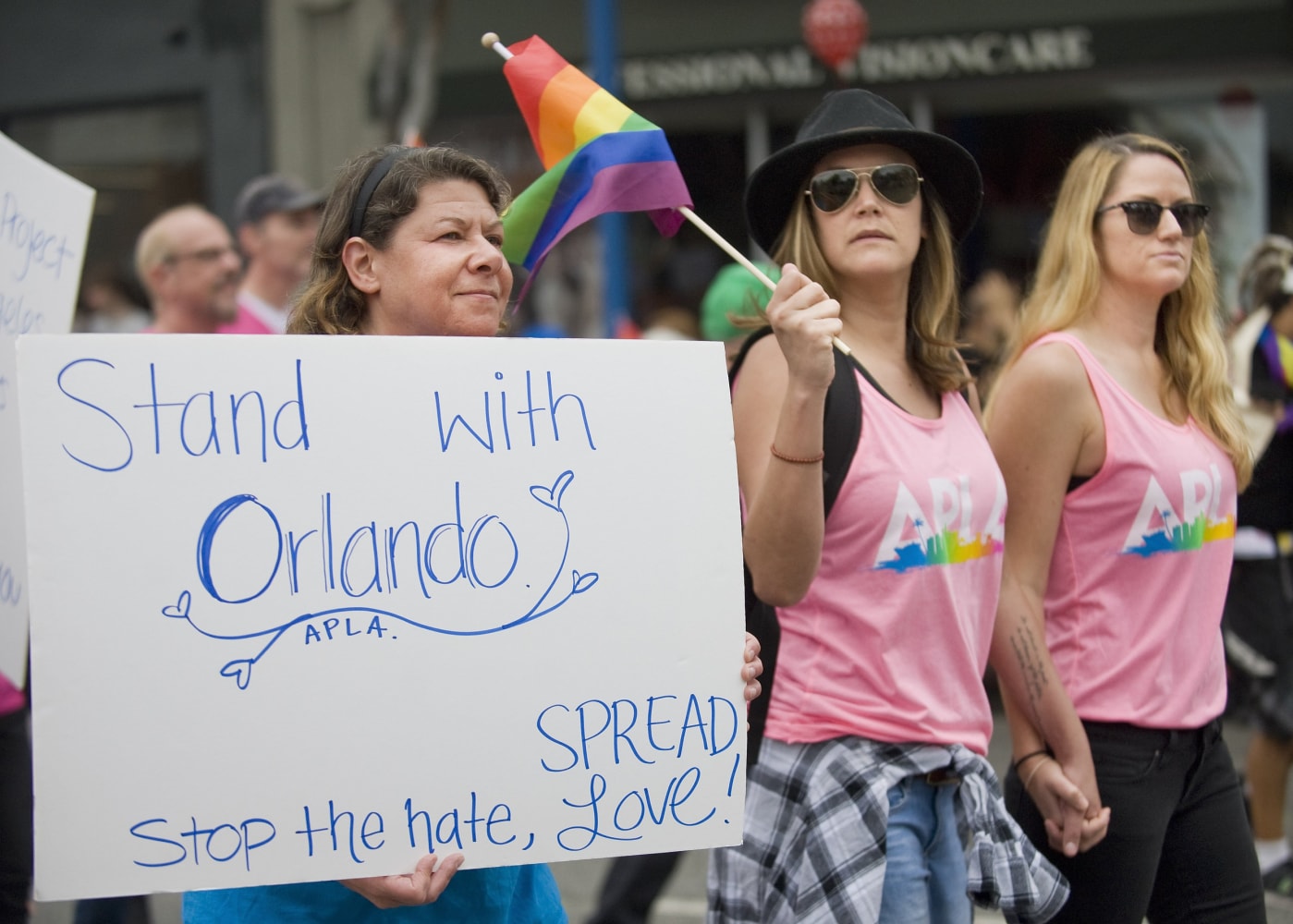

These are the touching
but ultimately empty gestures of a culture that is already resigned to losing
the clash of civilizations. They will do nothing to save lives the next time
around – and there will continue to be many more “next times” throughout the
West until we say no more, until we refuse to accept that suffering terrorist
savagery is our new normal. We must reverse our mindset, think like conquerors
instead of the conquered, and deal aggressively with the source of all this misery:
Islam.
In the wake of the
Orlando massacre, the calls to fight this relentless evil with love were
legion. Shark Tank co-host Robert Herjavec’s tweet exemplifies their
sincere but impotent heartache: “There are just no words,” he wrote. “Nothing seems
appropriate enough. Just choose Love. Love Wins #PrayersForOrlando” With all
due respect to Herjavec, my favorite TV entrepreneur, choosing love isn’t
enough when someone else has chosen to kill you. In the face of such a
merciless enemy, it is not love we must choose but life, and we do that
by choosing not to be a victim, by choosing to fight back, by choosing to kill
if necessary. Choosing life by taking another’s may seem like a contradiction
or hypocrisy to the morally confused, but that is often the choice we are given
in the eternal clash of good and evil. And if we are unwilling and unprepared to
make that choice, the enemy will make it for us.
Big Government
harpy Senator Elizabeth Warren tweeted a similarly high-minded message. “That’s
the message of Pride,” she wrote. “That’s who we are. That’s how we’ll defeat
hate, & how we protect America.” She closed with the meaningless hashtag “#loveislove,”
a bland sentiment that is sure to soften the stony hearts of ISIS killers, if
only they would take a break from videotaping gruesome snuff films long enough
to read Warren’s Twitter feed. Sorry, Fauxcahontas, we will not defeat “hate”
and protect America through pride; it’s going to take going to war with
fundamentalist Islam, and that’s a bridge too far for leftists who are already
locked into what David Horowitz calls an unholy alliance with radical Islam.
For some reason
Nashville Mayor Megan Barry felt compelled to issue a similar statement about the Orlando
massacre. She momentarily hit the right note, calling the killings “pure evil”;
but then she kicked the legs out from under that assertion with this vomit-inducing
solution: “We must meet that evil with an overwhelming show of love.” No, we
must meet evil with an overwhelming show of righteous force.
The cast of the Tony-winning historical musical Hamilton
symbolically
acknowledged the Orlando terrorism by performing that Sunday evening without
muskets – a pathetic misfire of a gesture which did not target jihad at all but
rather steered the issue toward the left’s foremost obsession (well, second
only to transgender bathrooms): gun confiscation.
Speaking of Tonys,
host James Corden opened Sunday night’s Tony Awards in New York City with a
somber announcement about “the horrific events” in Orlando (Islam was never
mentioned, of course, nor was the word “terrorism”). “Your tragedy is our
tragedy,” he intoned, referring to the audience behind him who apparently were
so traumatized by the Orlando atrocity that they could find healing only by
attending a black tie event of Broadway theater entertainment. “Hate will never
win,” Corden promised, to an explosion of applause.
I have news for
Mr. Corden and everyone on Twitter who feels that an abundance of #LoveWins
hashtags will somehow crush ISIS: jihadist hate most certainly will win
if we, all of us, don’t drop the mushy platitudes and begin fighting in a very
literal sense for our lives, our families, our country, and our
civilization.
The very first
step is for all of us, from our leadership on down, to acknowledge that the
root cause of all this butchery is Islam – not the AR-15, not the NRA, not “easy
access to guns,” not colonialism, not “Islamophobia,” not the alienation of
Muslims from society, not global warming, not poverty, not the Tea Party, not
“a tiny minority of extremists,” not the Israeli “occupation” of “Palestine,”
not some amorphous “hate,” but the racist, violent, theocratic, supremacist
ideology of Islam. Our leaders from the White House on down must be
unafraid to state that the world has a jihad problem, and to express a
determination of Churchillian magnitude
to defeat it.
Beyond that, there
are some glaringly obvious concrete steps we must take. In no particular order,
here are a few for a good start: vote the radical left and RINOs out of office;
fight to your last breath for your 1st and 2nd Amendment
rights; marginalize or better yet shut down all the Muslim Brotherhood legacy
groups, whose mission is to destroy us from within – from CAIR to the Islamic
Society of North America to the Muslim Students Association and all the rest;
shut down imams who foster radicalism; get serious about our borders and our
immigration policies; make a thorough housecleaning of every security-sensitive
position from Homeland Security to airport baggage handling; lay merciless
waste to ISIS.
Don’t get me
wrong. Gestures of solidarity can be psychologically empowering, though it’s
doubtful they will demoralize the fanatical enemy we are facing. Hashtags, as
silly as they often are, can spread awareness. The power of love is unquestionably
transformative. But love can change only one willing soul at a time; it cannot
in one fell swoop erase the cruelty and hatred from the hearts of ISIS or from
generations of fundamentalist Muslims brainwashed to love death more than life
and to despise infidels with a murderous fury. Changing the enemy through love sounds
beautiful but in reality is an incremental – sometimes even generational – process
and not a strategy to reverse the tide of evil now.
Mourning the
victims of violent jihad brings us all together as Americans. Enough. Now it’s
time that we are just as united by our resolve to eradicate this scourge.
From FrontPage Magazine, 6/14/16
Subscribe to:
Posts (Atom)