
Monday, April 27, 2015
Mark Tapson in the New York Post

Sunday, April 26, 2015
Trudeau: ‘Charlie Hebdo’ Reaped a Bitter Harvest

Under the title “The Abuse of Satire,” The
Atlantic posted the text of
remarks Doonesbury cartoonist Garry Trudeau delivered recently at Long
Island University upon receiving an award. In his address, the satirist spoke
about the “red line” that satire must not cross; as an example of such a
transgression he cited Charlie Hebdo’s cartoon assault on the sacred
cows of Islam – an assault that resulted in the murder of the French magazine’s
staff. In faulting them, Trudeau was essentially blaming the victims and absolving
their Islamic butchers.
“I, and most of my colleagues,” he said, “have spent a lot of time
discussing red lines since the tragedy in Paris.” Apparently that discussion
didn’t result in the use of clear, honest language to describe the attack at
the Hebdo offices, which was not an
act-of-God tragedy like a tsunami; it was a massacre for which Islamic
terrorists were solely responsible.
In any case, as background Trudeau mentioned the example of the Muhammad
cartoon controversy that began eight years ago in Denmark, when Muslim
provocateurs took an obscure collection of satirical cartoons that were
unflattering to Islam and used them to inflame outrage throughout the Muslim
world, resulting in worldwide riots and the deaths of dozens. Trudeau saw those
cartoons as intentionally and needlessly provocative. He criticized the “free
speech absolutists,” who defended the cartoonists, for rejecting judgment and
common sense, and the cartoons themselves for serving no positive social end.
Similarly, Trudeau claimed, Hebdo “succeeded in provoking many Muslims throughout
France to make common cause with its most violent outliers. This is a bitter
harvest.” This is a common argument from the left – that criticism or ridicule of
Islam drives the “moderates” into the arms of the fundamentalists. The left
never bothers to ask itself why the “moderates” themselves don’t rise up en masse to defy the “tiny minority” of
fundamentalists who have supposedly hijacked their religion, or why “moderates”
would, under any circumstances, ally themselves with medieval butchers whose
goal is the elimination of western civilization.
As a Christian, it would never occur to me to respond to attacks on
Christianity (which are legion) by enlisting in the Lord’s Resistance Army or joining
the Westboro Baptist Church (both of which, in any case, are satanic
perversions of Christianity that no church authority sanctions – unlike the
case with Islamic radicals).
Trudeau noted that satire is supposed to afflict the comfortable, to
“punch upward” against authority. It’s “the little guy against the powerful.”
But “ridiculing the non-privileged is almost never funny—it's just mean”:
By attacking a powerless, disenfranchised
minority with crude, vulgar drawings closer to graffiti than cartoons, Charlie
wandered into the realm of hate speech, which in France is only illegal if
it directly incites violence. Well, voila—the 7 million copies that were
published following the killings did exactly that, triggering violent protests
across the Muslim world, including one in Niger, in which ten people died.
This is shamefully misleading. The staff of Charlie Hebdo did not die violent deaths because they ridiculed the
helpless “non-privileged”; they died because, unlike all but a few cartoonists
and satirists, they refused to be cowed by fanatical savages that wield an ever-increasing
degree of power in the civilized world.
Muslims are a minority in the West but they are not non-privileged, powerless,
or disenfranchised. They are accorded the same rights and opportunities as
everyone else; they are actively supported and protected by the guardians of PC
multiculturalism in government, academia, and the media; and their increasing demands
for special consideration are almost always granted. To whatever extent they
are not integrated into western culture, it is because the fundamentalists
among them actively reject assimilation and seek instead to establish a
parallel culture.
“It’s not easy figuring out where the red line is for satire anymore,”
declared Trudeau. “But it’s always worth asking this question: Is anyone,
anyone at all, laughing? If not, maybe you crossed it.” But in Hebdo’s case the purpose was not so much
to make people laugh as to stand up for free speech in defiance of a rising
tide of violent Islamic hatred and intolerance. The fact that the satirical
jabs drew gunfire in response was a good, if terrible, indication that the
satirists were directly over the target.
But “what free speech absolutists have failed to acknowledge,” Trudeau
continued, “is that because one has the right to offend a group does not mean
that one must. Or that that group gives up the right to be outraged… At some
point free expression absolutism becomes… its own kind of fanaticism.”
How predictable that a leftist considers the defense of free speech
fanatical, but he will not apply that label to the butchers of Paris. And he
has set up a straw man here: the defenders of free speech never said that
offense must be given, or that the
target of offense has no right to be offended. They assert only that no one has
the right to shut down free speech by claiming
offense, much less to go on a killing rampage in revenge for it.
“As Jon Stewart said in the aftermath of the killings, comedy in a free
society shouldn’t take courage,” Trudeau says. But today it does, because we
are under assault from barbaric ideologues who don’t find anything funny but
the screams of dying Christians, and whose response to ridicule and criticism
is murder. The proper response of the citizens of a free society is to stand
with the satirist, not stand over his grave wagging a finger and blaming him
for his own murder. That is the way of cowards and appeasers.
The real “bitter harvest,” as Trudeau puts it, is a Western culture
weakened from within by irresponsible Islamic immigration and by cultural
jihad, and victimized by jihadist violence. Yes, the Charlie Hebdo murders were a bitter harvest, but they stemmed not
from the magazine’s satire but from the seeds of multiculturalist tolerance
planted by progressives like Trudeau.
(This article originally appeared here on FrontPage Mag, 4/23/15)
Sony, PBS, and Affleck Conspire to Bury His Slavery Connection
In the PBS program Finding Your Roots, guest stars ranging from Barbara Walters to
Derek Jeter to documentarian Ken Burns explore their genealogy and are often
taken aback at what is uncovered. Actor Don Cheadle, for example, was stunned
to learn (in an earlier incarnation of the show) that his ancestors were slaves
– not of white Southerners, but of Cherokee Indians. But it recently came to
light that for the first time, a celebrity pressured the show’s producers to
bury his own ancestral connection to slavery.
The show is hosted by Henry Louis Gates, Jr.
You may remember him as President Obama’s Harvard friend whose justifiable
arrest in 2009 prompted Obama to announce to the world that the Cambridge
police “acted stupidly.” A hacked Sony email from July 22 of last year,
recently posted on WikiLeaks, has uncovered an embarrassing exchange in which
Gates wrote to Sony USA chief Michael Lynton, saying “I need your advice”:
One of our guests has asked us to edit out something about one of his
ancestors–the fact that he owned slaves. Now, four or five of our guests this
season descend from slave owners, including Ken Burns. We’ve never had anyone
ever try to censor or edit what we found. He’s a megastar. What do we do?
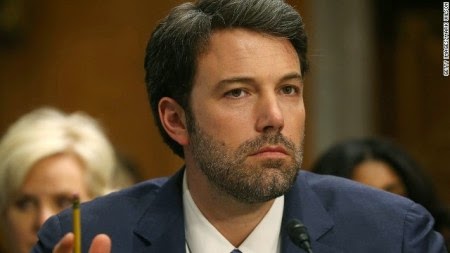
That megastar is actor/director Ben Affleck.
You may remember him from his dustup
with notable atheists and Islam critics Bill Maher and Sam Harris on Maher’s
show Real Time last October,
which I wrote about for FrontPage here.
In that heated confrontation (well, Affleck
was heated; Maher and Harris tried to reason with him), noted lefty Affleck
attacked the pair for what he considered their Islamophobic positions on the
Religion of Peace.
Making his Batman debut in the upcoming movie
Batman vs Superman: Dawn of Justice,
Affleck no doubt feared that his representation of the iconic superhero – not
to mention his own reputation – would be tarnished by a familial connection to
slavery. So the actor confidentially asked PBS executives to excise that from his family tree after it was exposed
during filming.
To answer Gates’ question to Sony’s Lynton
about how to handle the request, the right thing to do would be to treat a
megastar the same as you treat every other guest on the show. But Lynton’s
response was positively conspiratorial:
The big question is who knows that the material is in the doc and is
being taken out. I would take it out if no one knows, but if it gets out that
you are editing the material based on this kind of sensitivity then it gets
tricky. Again, all things being equal I would definitely take it out.
So the Sony chief was fine with suppressing
the inconvenient truth as long as “no one knows” and that it never came to
light. Spoken like a politician at heart.
To his minor credit, Gates replied that concealing
the material would be a violation of PBS rules, “even for Batman,” and would “compromise
our integrity.” As for Lynton’s question about who knew, Gates said, “All my
producers would know; his PR agency the same as mine, and everyone there has
been involved trying to resolve this; my agent at CAA knows. And PBS would know.”
Gates ultimately figured out how to handle the
dilemma: cave in to Affleck but minimize the damage publicly by claiming that
Affleck’s slave-owning ancestor wasn’t a big enough deal to be included in the
program itself. And indeed, it wasn’t included: Affleck’s episode of the show aired
last October 14 and focused on the actor’s more admirable ancestors, including
a Revolutionary War combatant and Affleck’s own mother, a civil rights marcher.
The slave-owner didn’t get even a walk-on.
Gates released a statement that explained:
“Ultimately, I maintain editorial control on all of my projects and, with my
producers, decide what will make for the most compelling program. In the case
of Mr. Affleck — we focused on what we felt were the most interesting aspects
of his ancestry.”
PBS backed up Gates. According to their statement,
“[Gates] has told us that after reviewing approximately ten hours of footage
for the episode, he and his producers made an independent editorial judgment to
choose the most compelling narrative.”
After the news of Affleck’s request began to
gather momentum in the media, Affleck himself released a statement in which he
said he felt “embarrassed” by the revelation, that “it left a bad taste” in his
mouth, and that he “didn’t want any show about my family to include a guy who
owned slaves.”
But he needn’t feel embarrassed. No shame
should accrue to Ben Affleck, or to any of us, simply because of the sins of our
fathers; conservatism teaches that we are individuals responsible for our own
actions and beliefs, not those of our ancestors or others of our race or gender
or any other group classification we may fall under. We are certainly not
responsible for horrors committed under a past institution that every rational
person today considers abhorrent. Therefore, while it may be interesting that
Affleck has a slave-owning ancestor, it’s not his fault.
But progressives are collectivists. You are
not an individual, they claim; you are your demographic. If you are white, as
Affleck is, your skin color marks you as one of the oppressors, which is why
rich white progressives like him bend over so far backward to identify with or
defend the supposed oppressed (as he believed he was doing in his argument with
Maher about Muslims). Therefore, a slave-owning relative in Affleck’s past is
an embarrassment that colors the way other progressives might see Affleck, and
the way he sees himself. So it must be suppressed.
Secondly, imagine if the subject of the show
had been an openly conservative actor rather than a multiculturalist progressive.
Had the show turned up a genealogical connection between a slave owner and Jon
Voigt or Clint Eastwood or Kelsey Grammer or Tom Selleck or Mel Gibson or James
Woods or Robert Davi or Nick Searcy, does anyone believe for a moment that the
producers wouldn’t have pounced on it as that episode’s “most compelling
narrative”? Had any of those actors privately requested that the show avoid
mentioning his connection to slavery, does anyone believe that Gates, Sony and
PBS would have colluded to find a way to help him save face?
(This article originally appeared here on FrontPage Mag, 4/24/15)
Thursday, April 23, 2015
Jeremy Renner, Action Dad

As the helplessly smitten father of two
little girls (with a third on the way), I have a soft spot for stories about
manly dads who freely confess to being wrapped around their daughter’s little
finger. So I was touched when Fox News reported that tough guy action star Jeremy Renner recently gushed about his two-year-old
Ava Berlin in an interview with Ellen DeGeneres that will air Wednesday.
Ava is the daughter of Renner, 44, and
Canadian model Sonni Pacheco, who married in early 2014 almost a year after
Ava’s birth. Renner was grateful that he married late in life, after some
career success, so he could afford to concentrate on family. Fatherhood “really
kind of changed my perspective on a lot of things,” he told DeGeneres. “It’s kind of screwed my career in a lot of ways, because I
don’t really care about it so much because I care about her so much. She’s, like, number one in my life. And now I get to
do movies on the side.”
To be clear, his career is still very active but
he has a different motivation now. In an interview with Capitol File magazine, Renner said,
The only thing I think about when I’m not
with my baby is, “How do I get to my baby?” I need to get to her, and I’m very
miserable when I don’t see her. I really love being a father. The only thing
that has changed is my perspective on things. I still work, probably even more.
It used to be all for myself, so I’m not old and broke. All these things I
still do, but I do it now for the future of my baby, and if it gets in the way
of her well-being, then I stop.
Balancing his profession and fatherhood is
challenging because of the travel demands, but Renner claims to make every
effort to stay as present in Ava’s life as possible. “I do a lot of flights
back,” he said to DeGeneres. “I did like forty flights back. From London to [L.A.]
pretty much every other week. [I] see her sometimes for eight hours and then
fly back.”
Fatherhood is “the best thing ever,” Renner said in a Today show segment last October. “Now I
know what real love is, what real existence is. Best thing that I've
experienced in my life.” As clichéd as that may sound to someone who doesn’t
yet have children, as it did to me before I
had kids, I can vouch for the truth of it. Fatherhood is a humbling gift that
throws you suddenly out of the center of your universe and puts you in orbit
around your child instead – as it should be. Good on Renner for recognizing
this and embracing it.
Unfortunately, as Hollywood couples often do
– and “ordinary” couples too – he and Sonni broke up last December after less
than a year of marriage. It’s unclear what went wrong, but a source told E! News that Renner “wanted to make sure Ava had a solid family unit and
tried to make it work. It’s really sad because Jeremy loves Ava so much and
hates that she will live her life with her parents split up.”
Pacheco asked that the court grant her full physical custody of their daughter. The E!
News source said at the time that the custody battle “is going to get ugly. His
main priority is the baby and he will fight for full custody if it comes to
that. All he cares about is being a dad. He is an amazing father. He is worried
she is going to go back to Canada and take the baby.” Apparently he won at
least a partial victory; earlier this month it was reported that Renner and Pacheco were awarded joint physical custody of the
little girl, so he gets more than just visitation rights.
“Daddy’s my best role to date, I think,” the
star of The Hurt Locker and Avengers told Ellen DeGeneres to big
applause from her charmed studio audience. But a father actively involved in
his little girl’s life isn’t just adorable and admirable – it’s also essential
but increasingly rare: one out of three American children now live
in homes without the biological father, as compared to 11% in 1960. That is an alarming decline, considering
the devastating impact that fatherlessness has on children and ultimately on
society.
As Dr. Meg Meeker puts it in Strong
Fathers, Strong Daughters,
a father is the most important man in his daughter’s life. Girls (boys too, but
let’s focus on the girls) need their fathers’ guidance, strength, wisdom, and
loving presence in their lives. Children are adrift without that, and they
often grow to become adults adrift as well.
When an action hero like Jeremy Renner gushes
in the media about his daughter and the joys of fatherhood at every
opportunity, his joy and commitment set an excellent example, especially for
the young male fans who themselves will someday be fathers of little girls.
Hopefully his influence will contribute in some small way to the reversal of
that slide toward more fatherless kids.
(This article originally appeared here on Acculturated, 4/23/15)
‘Scary Lucy’ and the Flight from Beauty

It’s a commonplace today that contemporary
art is too often silly, incomprehensible, ugly, or even disgusting. But it
isn’t often that a work of art is actually considered terrifying.
Recently the hometown fans of legendary comedienne
Lucille Ball were stricken at the unveiling of a rather nightmarish bronze
statue in her honor. Rightfully nicknamed “Scary Lucy” in the media, it purports to depict Ms. Ball, who died in 1989, in
perhaps her most famous comedy routine: as a commercial pitchwoman for the unpalatable
“Vitameatavegamin.”

The statue caused such a backlash among the
outraged citizens of Ball’s birthplace of Celoron, New York that its creator actually wrote to The
Hollywood Reporter to
publicly apologize for what he called “by far my most unsettling sculpture,”
and to offer to fix it.
This prompted The Guardian’s art critic Jonathan Jones to address the bigger
picture of bad sculpture in a rant with the outstanding title, “The scourge of the bronze zombies: how
terrible statues are ruining art.” Jones declared that
it may be time to ban artists from creating statues. They have simply lost
the ability to do it. The art that once gave us Michelangelo’s David and Rodin’s Burghers of Calais has degenerated into a cynical province of
second-rate hacks who are filling up city squares, railway stations and other
public spaces all over the world with ugly, stupid and occasionally terrifying
parodies of the human form.
Don’t hold back, Mr. Jones. Tell us how you
really feel.
In addition to “Scary Lucy,” Jones went on to
name two other statues in London as examples of such “crimes against good taste,”
including the ghastly A
Conversation with Oscar Wilde near Trafalgar Square, which depicts what appears to be the decomposing
author bursting out of his coffin; a “gaunt and deathly” bust of Margaret Thatcher in the Falkland Islands; and, curiously, a statue of a raincoated Peter Falk as Detective
Columbo in Budapest, of all
places. “There’s only one thing to be said in favor of all these dire statues,”
Jones concluded. “Simply by looking at their failure, future generations may be
inspired to create better.”

What’s with the apparent epidemic of ugly
public sculptures? Jones is at a loss to explain it. After all, he wrote, “Modern
art supposedly killed off this kind of vulgar realism.” But modern – or more
precisely, postmodern – art, with its
deconstruction of the beautiful, is precisely what is to blame.
The experience of beauty, as philosopher
Roger Scruton puts it in a brilliant little must-read from 2009 called Beauty:
A Very Short Introduction,
is a reverential one in which art “points us beyond this world, to ‘a kingdom
of ends’ in which our immortal longings and our desire for perfection are
finally answered.” The yearning for beauty is our aspiration “towards the
highest unity with the transcendental,” and the most emotionally and
philosophically compelling art fulfills that aspiration.
But postmodern art represents what Scruton
calls “a flight from beauty” that no longer points us toward the sacred;
indeed, it actively seeks to desecrate the sacred. The result, he says, is the rise
of “self-consciously transgressive” works that do not engage us spiritually or
emotionally; they leave viewers cold, confused, even repulsed. “The degradation
of art has never been more apparent,” Scruton declares in his book – and as the
Guardian critic Jones noted, it’s plenty
apparent in today’s public sculpture.
What then can be done to reverse the tide of
ugly public art? For a start, we can follow the example of the people of Celoron,
New York by complaining loudly about bad art and demanding its removal. Maybe
this will begin to send a message to artists and their sponsors that we will no
longer accept fraudulence or kitsch or contempt for beauty in the public
square. Perhaps it will encourage sculptors once again to find value in beauty,
and to strive to unite us with the transcendental.
(This article originally appeared here on Acculturated, 4/22/15)
Obama’s Divine Rainbow
Just when you think the left’s passionate idolatry of Barack Obama might
be waning a bit after six years in office, along comes a photo posted recently on
the White House official Twitter account to remind you of the President’s divinity.
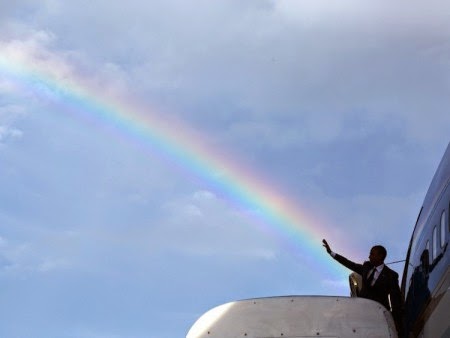
The image appears to show the Messiah-in-Chief shooting a rainbow out of his
palm, as only God or perhaps an LGBT Spiderman can do.
After clinching the “framework” of a nuclear deal with our enemy the Iranian
regime in which the President made doormat Neville Chamberlain look like Winston
Churchill, Obama traveled to Kingston, Jamaica recently to speak to impressionable young fans, lecture the leaders of Caribbean countries
about fighting global warming global cooling climate change
bad weather, and tour a museum dedicated to fellow marijuana enthusiast Bob
Marley.
At his departure at the end of the week, a gorgeous rainbow happened to
be arcing overhead as Obama climbed the stairway to Air Force One. White House
official photographer Paul Souza captured, or manipulated, a shot of the
rainbow seemingly emanating from the President’s hand as he waved goodbye at
the plane’s door. Souza posted the pic on Twitter with this accompanying affirmation
from Obama: “With hard work and hope, change is always within our reach.” But
the subtext was, “And as a sign of my power, mortals, behold as I call forth
rainbows.”
In Biblical terms, the rainbow is a symbol of God’s postdiluvian promise
to humankind that He will never again destroy the earth by water. But
apparently Obama’s PR people have decided to rebrand the rainbow now as a
symbol of The One’s divinity and of his promise to Jamaica that, like General
MacArthur or Jesus, he shall return. He’ll come back someday to bask in more sunny
Third World adoration, hit the island’s finest golf courses, and, if he has
time, entertain the masses with a spray of shooting stars from his fingertips.
(Speaking of fingertips: another interpretation is that the photo was
intended to suggest not that the President himself is godlike, but that God produced
the rainbow to touch Obama as a sign of His favor, much like Michelangelo’s God
stretches out his finger to bestow the spark of life on Adam in the Renaissance
artist’s “Creation of Adam.” Either way, the implication is that Obama
is no mere mortal.)

Reactions from the leftist media were predictably awe-struck. The gay
online magazine Out declared that “it’s
impossible not to read into the [photo] a continuation of President Obama’s
increasingly aggressive drive for LGBT rights and equality.” “Now This Is One
Hell of a Rainbow Photo,” Mother Jones
approved. “White House photographer Pete Souza caught this incredible shot of
President Obama departing Jamaica. Beautiful. Massive,” gushed
the radical feminist site Jezebel.
The photo is reminiscent of the deifying propaganda we’ve been subjected
to ever since Obama’s first election, when he was supernaturally expected to
“slow the rise of the oceans and heal the planet. Remember when schoolchildren
across the country were coached to sing his praises like good little
totalitarian youth? When the media relentlessly promoted images of his haloed head? When Newsweek
entitled a cover story about him “The Second Coming”? And when celebrities like
Jamie Foxx and Sting referred to Obama as our Savior?

This new pic from his Jamaican jaunt is in the same vein of those disturbing
depictions of Obama as a demigod. It’s worthy of the degree of leader-worship
normally reserved for Pharoahic despots. When the boy tyrant Kim Jong Un sees
it, his architecturally-shorn head is going to explode from envy.
The photo reeks of such adoration that people heaped mockery upon it on social media. “Holy propaganda, Batman.
This would make any third-world dictator proud,” read one response on Twitter.
“Gotta reach that 'my little pony' demographic,” smirked another tweet,
referring to the Hasbro toy company’s Rainbow Ponies franchise. A third tweet:
“Messiah Much there Dear Leader? #Vomit.” Much more hilarious scorn can be
found here below the reverential photo on the White House Twitter feed.
In response to conservative accusations of idolatry, some progressives no
doubt will try to claim that Souza’s snapshot was intended to be a
tongue-in-cheek, lighthearted commentary on Obama as a beacon of hope. They
will brush off criticism of the photo as conservative humorlessness.
But nowhere in Souza’s or in the White House’s comments is there any
indication that the picture is intended as anything less than blatant
hagiography, designed not only to flatter Obama the Sun King himself, but also
to send a thrill up the collective leg of the masses of low-info voters who still
cling to his hope and promises despite mounting evidence of his destructive
agenda. On Pete Souza’s Instagram page, for example, reverential viewer reactions
to his photo ranged from the gag-inducing (“YES HE CAN!”) to the drug-addled (“God...makes
no mistakes...Obama came to shine a light on the beautiful”).
The progressive vision is a totalitarian fantasy world of peace (through
disarmament and capitulation), equality (through enforced social engineering
and the redistribution of wealth), and collective genuflection to big
government. And no totalitarian vision is complete without a semi- or fully divine
Dear Leader to whom all love is directed and all submission required. It is an
ideal that demands the denial of reality, of history, and of human nature, as
well as the worship of a false idol – but none of that is an issue for
progressives.
(This article originally appeared here on FrontPage Mag, 4/22/15)
Monday, April 20, 2015
Kelsey Grammer’s Lesson of Forgiveness

Our common fate, Longfellow once wrote, is that "into each life some rain must fall." But some people have to weather heavier deluges than others, and being a
celebrity is no guarantee against that. In a recent Vanity Fair interview, Kelsey Grammer of Cheers and Frasier fame spoke recently about a history of more
family tragedy than anyone should have to bear, and how forgiveness – for
himself and others – has enabled him to cope.
The grandfather who raised him died of cancer
when Grammer was 11. Two years later his estranged father was murdered. His two
half-brothers died in a scuba-diving accident. Most disturbingly, his sister Karen
was 18 years old when she was abducted, raped repeatedly, and brutally murdered
in Colorado by thrill killer Freddie Glenn and accomplices in 1975.
When Glenn was finally eligible for parole in
2009, Grammer wrote a powerful letter to the parole board (part of which he struggled to read aloud to Oprah
Winfrey in an emotional 2012 interview) describing Glenn as a butcher and a monster,
and eulogizing Karen, whose loss had devastated the surviving Grammers. “I was
her big brother,” he wrote. “I was supposed to protect her—I could not. I’ve
never gotten over it. I was supposed to save her. I could not. It very nearly
destroyed me.”
He went on in the letter to describe how
Glenn had further victimized not just those he killed but their families as
well. Then he concluded with his deeply considered reflections on forgiveness:
I am a man of faith and my faith teaches me
that I must forgive. And so I do. I forgive this man for what he has done.
Forgiveness allows me to live my life. It allows me to love my children and my
wife and enjoy the days I have left with them. But I can never escape the
horror of what happened to my sister. I can never accept the notion that he can
pay for that nightmare with anything less than his life. We all make choices.
He made his.
Glenn’s release was denied.
The Vanity
Fair interviewer pointed out that there was no way Kelsey could have been
expected to protect his sister, who lived in another state at the time. “It’s
not rational,” the actor answered. “But it happens anyway. I know a lot of
people who’ve lost their siblings and blame themselves.” At the height of his
success, Grammer said, when he wrestled with alcohol and cocaine addiction,
“That was the time when I could not forgive myself for my sister’s death.” It
was many years before he could begin to rid himself of that burden.
Last year Grammer again successfully opposed
another appeal from Glenn, although he was convinced for the first time of the
killer’s sincere contrition. “I accept that you actually live with remorse
every day of your life, but I live with tragedy every day of mine,” Grammer
told him via video during the hearing. “I accept your apology. I forgive you.
However, I cannot give your release my endorsement. To give that a blessing
would be a betrayal of my sister’s life.”
Grammer does see his own life as obviously
blessed in other ways, and he has “learned to soldier on” despite the
staggering personal losses. “Every one of us is going to experience some
terrible loss,” he concluded in the Vanity
Fair interview. “I just got a big dose. For every story you hear that’s
tragic, there’s another that’s equally tragic or more so. I think you come to
look at it as part of life.”
As all of us who have wrestled with it know,
forgiveness is no easy process, especially when the trespasses against us are
as traumatic as the murder of a loved one; it is a wrenching evolution that can
sometimes feel more painful than the wound we suffered, as the spiritual writer
Marianne Williamson says. Forgiving oneself
is often the most difficult step of all. Kelsey Grammer is living proof of the
demands it places on one’s body and soul to commit to that evolution. But the
alternative is a living death.
Now 60, Grammer is happily married to a woman
named Kayte Walsh, with whom he has two children (he has six in all). “This
lovely young woman,” he says, “lit up my world and changed my heart, which was
a bit calloused and hardened against a lot of things. And we are good, and I
feel young and alive.” I think he has earned that.
(This article originally appeared here on Acculturated, 4/20/15)
‘American Pie’ and the Day the Music Died

The Washington Post reported
last week that, in order to secure the financial future for his wife and
children, aging singer Don McLean sold the original 16-page working manuscript for the lyrics to his chart-topping
1972 song “American Pie” for $1.2 million at auction. Somehow this mundane,
practical gesture seems a sad but fitting end for a song that lamented the end of an era of cultural
innocence.
“American Pie” was inspired partially by the shocking
deaths of young rockers Buddy Holly, Richie Valens and the Big Bopper in a
plane crash in 1959. But it was about much more than “the day the music died,”
as one line goes; it rambled on with allusions to everyone from Karl Marx to Charles
Manson to Jackie Kennedy to The Beatles. “It was an indescribable photograph of
America that I tried to capture in words and music,” said McLean in a catalogue for Christie’s auction house. “Basically in
‘American Pie,’ things are heading in the wrong direction. It is becoming less
idyllic. I don’t know whether you consider that wrong or right but it is a
morality song in a sense.”
“American Pie is the accessible
farewell to the Fifties and Sixties,” wrote Guardian
music critic Alexis Petridis, who considered it Bob Dylan Lite. “The
chorus is so good that it lets you wallow in the confusion and wistfulness of
that moment, and be comforted at the same time.”
I was never a fan. I remember the hit playing
incessantly on the radio, and despite its catchy chorus, at 8½-minutes it was
well over twice the length of the average radio single and felt even longer.
McLean’s other big hit, “Vincent,” an achingly touching ballad about the
world’s inability to grasp the genius of Vincent Van Gogh during the troubled
painter’s lifetime, was much better lyrically and musically.
But I was very young at that time and had no
capacity for nostalgia. It would be a few more years before I got my first sense
for how easily important moments and people can slip into the past, lost
forever, sometimes before you even realize how much they meant to you. At the
time, living in the present was all I understood, and the future seemed
limitless and bright. But then I got older.
It’s natural – and not entirely wrong – for
every generation to reach an age when it waxes nostalgic about the past and complains
that the present is “going to hell in a handbasket,” as my parents used to say.
But in his mid-20s at the time, McLean was ahead of the curve in recognizing
that things were “heading in the wrong direction.” Now 69, he remains
lugubrious about the state of the culture: “I was around in 1970 and now I am
around in 2015. There is no poetry and very little romance in anything anymore,
so it is really like the last phase of ‘American Pie.’”
That is an overstatement – after all, there
are still poetry and romance in the world; you just have to dig through whole
strata of cynicism and snark and irony nowadays to find them. But he is correct
that our cultural ability to appreciate beauty, romance, and poetry has
atrophied, or at least been devalued in what an old friend of mine used to call
our Age of Ugliness, and that is a disheartening loss.
In a verse that didn’t make the final cut for
the song, McLean falls down on his knees and offers everything he has to give,
“if only He would make the music live again.” If only it were that easy; it
will take a new generation of artists who value sincerity over oh-so-hip
detachment to breathe life back into the culture. McLean has worthy advice to budding
songwriters: “Immerse yourself in beautiful music and beautiful lyrics and
think about every word you say in a song.”
The music may have died once, but that
doesn’t mean it can’t be resurrected.
(This article originally appeared here on Acculturated, 4/17/15)
Thursday, April 16, 2015
In the Shadow of a Celebrity Dad

Being the child of a celebrity parent is a
curse as well as a blessing. Being born into a life of wealth and glamour comes
with obvious perks, and many children of celebrities inevitably become
insufferable, spoiled brats, particularly if they aren’t blessed with a talent
of their own that distinguishes them from their famous parents. But for those who aren’t
content to sponge off the money and accomplishments of their parents forever, finding
their own way in the world can be especially frustrating.
Imagine, for example, being the son of Tom
Hanks, two-time Oscar-winner and arguably the most well-liked actor inside and
outside Hollywood. It may seem that being his son is like winning the birth
lottery, but how do you carve out your own identity, your own career, your own
success when your dad is such a celebrated household name?
One son, Colin, followed in his father’s
footsteps to become a fairly successful actor in his own right. But 24-year-old
younger brother Chester Hanks, the young man Gawker labeled “a frat boy rapper” who goes by the alias Chet Haze, seems to be
floundering at sea.
After radio show host Howard Stern mocked
Chet for his rapping ambitions, Chet called Stern out in a Twitter assault last week that read like a blustery attempt
to pump up his rapper cred. Here’s a sample of his profane, threatening rant
that reeks of affected street slang:
Let me come up on your show b*tch… Come catch
this fade… have me live on the air and we can go pound for pound see who
looks like the fool you dried up old c*nt catch this fade…
Do you have any idea how badly I am going to
assault you when I see you… it’s a shame you don’t hang in the same circles as
my family (not enough bread for that) cuz if you did I woulda already seen u.
Taunting Howard Stern for not being rich
enough to hang with the Hanks family is pretty comical, considering that
Stern’s estimated $550 million net worth is quite a bit more than Tom Hanks’
estimated $350 million. The failed insult also reveals an arrogance about his
dad’s money but what also must be a resentfulness – after all, the wealth he
boasts about is not his own.
Chet followed up with an unapologetic
description of himself as a “WALKING PR DISASTER” who does not “GIVE A SINGLE
F*CK!!!!” And then: “I DONT LIVE MY LIFE BY ANYBODYS RULES BUT MY OWN!!!” Methinks
the young man doth protest too much. He sounds as if he very much cares about
the opinions of others.
This isn’t Chet’s first defensive Twitter
feud (I’ve said it before and I’ll say it again: is there anything in the world
more inconsequential than a Twitter feud?). As noted in a Fishwrapper article called, “Sorry, but Tom Hanks Raised a Mega
Douche,” Chet got into it back in late 2013 with former rapper Jensen Karp, who
tweeted a barb about Chet’s lack of authenticity: “Your dad was in Castaway.”
This prompted an angry (but also poignant) response from Chet: “so cuz my Dads
famous, I can't do what I want to do in my life?” In the ensuing
back-and-forth, Karp offered Chet some blunt, if condescending, advice:
Chet, your father is Tom Hanks. America’s
sweetheart. And you’re talking about smoking kush and banging dime pieces. It’s
acting… I am actually not hating, I’m trying to help. No one wants to hear the
fake black accent from a kid who knows the Spielbergs.
Eminem and others have already proven that
being white is certainly no barrier to rap success, but Chet Haze’s bad boy posturing
seems to be more an act of rebellion against the expectations placed on him due
to his nice guy dad’s name (hence Chet’s name change, for example). If he
proves Stern and Karp wrong by earning real success on that route, then more
power to him. But I suspect that Chet is still searching for his own authentic
road.
Similarly, another would-be rapper – Deion
Sanders, Jr., son of the football legend and sports broadcaster who is
worth an estimated $40 million – found himself the target of some media ridicule
last week when he tweeted something about his life in “the hood.” His famous father
playfully but pointedly responded, “you’re a Huxtable with a million $ trust fund stop the hood stuff!
Lololol. Son. #Truth.” Huxtable, of course, was the surname of Bill Cosby’s affluent,
educated TV family – an association no self-respecting rapper wants.
At the risk of psychoanalyzing Deion Jr. and
Chet Haze from afar, my sense is that posturing as rap stars is just a phase
for these two. As difficult as it may be to sympathize with celebrity kids who
grew up with every comfort and opportunity, Chet and Deion Jr. strike me as two
insecure young men struggling to get out from beneath the shadows of their
celebrated, accomplished fathers and find their own identities, their own paths
in life. It’s a struggle they unfortunately must carry out in the harsh light
of the public eye, and they may have to take a few blows in the media such as
they did last week before they are humbled enough to reject everyone else’s
expectations, search their own hearts, and find their authentic purpose in
life.
(This article originally appeared here on Acculturated, 4/15/15)
Monday, April 6, 2015
Is Variety the Spice of Marriage?

Recently a woman named Robin Rinaldi published The
Wild Oats Project: One Woman’s Midlife Quest for Passion at Any Cost, the tale of her one-year experiment with an open marriage in her mid-40s. The result of that
experiment highlights an important truth about marriage, fidelity, and sexual
intimacy.
Feeling the passion seeping out of her childless marriage, Rinaldi
decided to act on her craving for “seduction and sexual abandon” and sow some
wild oats. She presented her husband Scott with an ultimatum about experimenting
with other, purely sexual, relationships, and he reluctantly agreed. They lived
apart during the weekdays, when Rinaldi saw other people; then she returned
home on weekends to resume their marriage as if nothing had happened.
But quite a bit did happen. Rinaldi had twelve lovers and oodles of great
sex in that year, but her “quest for passion at any cost” cost her her 18-year
relationship with Scott. “After you open up a marriage and experience a whole
range of sexual variety and aspects of yourself you’ve never had before,” she
admits, “it’s hard to put everything back in the box.” No kidding?
Not that leaving him bothered her. She’s “grateful” she “experienced” her
marriage, but she moved on to be with one of the partners she met, someone
“from whom I can learn more.” [In my experience, people whose focus in a
marriage is primarily their own personal growth never stay married – but that’s
a topic for another day.]
Back to marital passion, or the lack thereof. In a recent article called “When the Best Sex Is Extramarital,” New
York psychotherapist Lawrence Josephs asked, “What do you do when” – like Robin Rinaldi – “the best
sex of your life is outside of marriage but you still want the emotional
security of a stable long-term relationship with someone you love and trust?” Josephs
says he’s worked “with a few couples over the years who have been able to make
an open marriage work, but most people… are too insecure and jealous to do so… When
it comes to our spouses, it seems most of us never outgrow being fundamentally
childlike in our possessiveness.”
Insecure, jealous, childlike? Josephs seems to be suggesting that spouses
who aren’t comfortable with their partners’ extramarital promiscuity simply
aren’t mature enough to handle it. The implication is that a married couple who
are okay with sleeping around are somehow exhibiting more adult behavior than a
couple who demonstrate fidelity. The fact is that the vast majority of people
believe marriage should be fundamentally a lifelong physical, emotional, and
spiritual commitment to one other person, and they’re less than thrilled with
the idea of that person finding intimacy and ecstasy with other partners – not
because they’re too immature, but because sharing their partner erodes, if not
demolishes, a marriage’s foundation of love, trust, respect, and unity.
Yes, marriages fail too much of the time, but pretty much everyone enters
into that union under the assumption that their partner is the one. Commitment and fidelity are often put to the test, but
that’s what commitment and fidelity mean:
staying the course of your vow despite temptations.
And besides, is marital passion necessarily doomed? In another recent
article, “Married Sex Gets Better in the Golden Years,” Jan Hoffman refers to a new study which
concludes that, for couples who do hang in there, there is a payoff. While sexual
activity among most long-married couples reportedly declines steadily over the
years, those married more than 50 years reported an uptick in their sex lives –
and the frequency continued to improve.
Samuel Stroope, the study’s lead author and an assistant professor of
sociology at L.S.U., said that in a long marriage, sexuality suffers from
“habituation,” the familiarity that can dull a couple’s desire over time. At
the same time, however, long-timers accumulate valuable “relationship capital.”
In good marriages, he said, you’re “accumulating experience and knowledge about
your intimate partner over time that builds on itself.” That leads to more
intimacy, more meaningful sex.
Gerontologist Dr. Karl Pillemer, whose new book 30
Lessons for Loving is
drawn from 700 interviews, discovered that older adults “place intimacy as a
high priority.” He cites the example of Jennie B., now an 82-year-old widow who
married her first and only husband when they were in their mid-20s, and were
sexually active through their 47 married years before his death in 2003. Jennie
explained,
There’s an intimacy that comes later that is
staggeringly wonderful. You can hold hands with this person you love and adore,
and somehow it’s just as passionate as having sex at an earlier age. There is
such a sense of connection and intimacy that grows out of a long relationship,
that touch carries with it the weight of so many memories. And many are sexual.
Indeed what she misses most as a widow, she says, is holding hands. “Sex was certainly an important and joyful and
healing part, but I’m not sure that the connection through holding hands, which
elicited such peace, was not a deeper intimacy,” she wondered.
Sex is a vital part of our humanity and our relationships. But more
meaningful, and more human, is the intimacy that grows through a longstanding
monogamous commitment – and sex is only one strand of that powerful bond.
(This article originally appeared here on Acculturated, 4/1/15)
Subscribe to:
Posts (Atom)