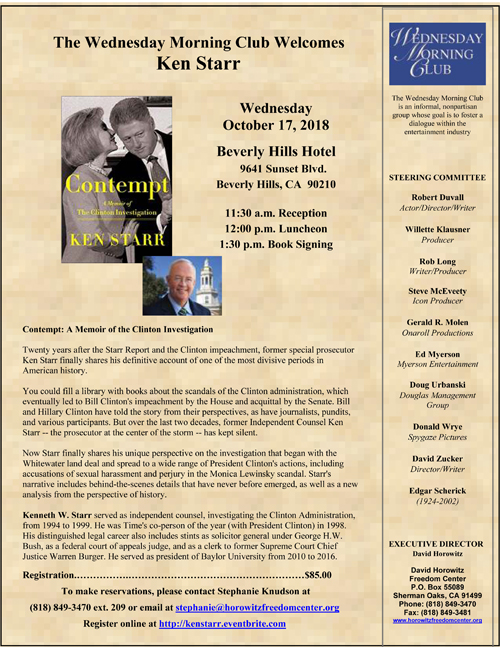
On Wednesday at the Beverly Hills Hotel I interviewed former Clinton prosecutor Ken Starr about his new book Contempt, before a lunch crowd of the Wednesday Morning Club. A good time was had by all. Here are a few pics...
Thursday, October 18, 2018
Jim Jones, Harvey Milk, and 10 Days That Shook San Francisco
We are approaching
the 40th anniversary of two shocking events that most people are
unaware are linked: the assassinations of San Francisco Supervisor Harvey Milk
and Mayor George Mosconi by disgruntled Supervisor Dan White in November, 1978,
and – ten days later – the ghastly, bizarre murders and suicides of 918 cult
followers at Jonestown, which constituted the largest loss of civilian life in
American history (until the terrorist attacks of the morning of Sept. 11, 2001)
and the largest mass suicide of the modern era.
These dark
episodes have been brought back into the light in an investigative new page-turner
titled Cult
City: Jim Jones, Harvey Milk, and 10 Days That Shook San Francisco
by Daniel J. Flynn, also the author of The War on Football: Saving America’s
Game, Blue Collar Intellectuals: When the Enlightened and the
Everyman Elevated America, A Conservative History of the American
Left, Intellectual Morons: How Ideology Makes Smart People Fall for
Stupid Ideas, and Why the Left Hates America.
I interviewed the
author via email about his just-released book, recently reviewed at FrontPage
Mag here.
Mark Tapson: Your book dispels some widely-held
myths about both the murder of Harvey Milk and the Jonestown mass suicide. For
example, Milk swiftly became a martyr for the gay community after his
assassination, and the media helped promote this. What is the truth about Milk
and about why Dan White targeted him?
Daniel J. Flynn: Looking to make sense of a senseless
crime, gay activists immediately advanced a narrative that Dan White killed
Harvey Milk because of his homosexuality. I interviewed White’s campaign
manager, chief of staff, and business partner, a gay man, who rejects this
thesis. As I detail in Cult
City: Jim Jones, Harvey Milk, and 10 Days That Shook San Francisco,
White occasionally supported liberal causes, including some gay-rights
measures, and generally thought of Milk as a friend during his short time on
the board —particularly in the first few months. Harvey Milk’s homosexuality
had as much to do with his murder as George Moscone’s heterosexuality had to do
with his death.
Dan White murdered
Harvey Milk because he believed that Milk had aggressively lobbied San
Francisco Mayor George Moscone to prevent the supervisor from reclaiming the
seat he had resigned from on the board. Moscone initially refused, in a very
public way, to accept White’s resignation. But after Milk and others persuaded
him to go back on the words he had uttered to the media Moscone decided to
appoint someone more inclined to vote his way on the board. In other words, a
petty man nursing a petty grievance lashed out against the two men he believed
most responsible for denying him the $9,500-a-year job back from which he had
recently resigned. He should have blamed himself. Instead, he blamed others—and
sought revenge.
White felt
betrayed by Milk and Moscone. Perhaps more importantly, he came to feel that in
abruptly resigning he had inadvertently betrayed allies—their identities,
importance, and the nature of their dependence on White which I will leave for
a fuller explanation in the book. That’s part of the untold story. Another
untold part of the story involves White’s history of violence. Out of my
interviews came several shocking revelations and accusations involving White on
this front. As Dianne Feinstein, White’s mentor on the board of supervisors, reflected
long after the fact, “This had nothing to do with anybody’s sexual
orientation.”
MT: Another
myth stems from the favorable media coverage then and now about the Peoples
Temple, which turned the Jonestown horror into a cautionary tale about the dangers
of evangelical Christianity. What’s the truth about the Peoples Temple?
Why You Must See ‘Gosnell’
Masked by
innocuous language like “pro-choice” and “reproductive care,” and protected by
a media conspiracy of silence, the grim reality of abortion rarely surfaces in
our cultural awareness. But a new movie, drawn from a real-life courtroom drama
that exposed what is arguably the deepest, darkest episode in American abortion
history, is poised to have a dramatic impact.
Directed by openly
conservative Justified star Nick Searcy, who does double-duty playing
the role of the defense attorney, and written by novelist and political pundit
Andrew Klavan, Gosnell: The Trial of America’s Biggest Serial Killer is
based on the riveting book Gosnell:
The Untold
Story of America’s Most Prolific Serial Killer, written by investigative journalists and filmmakers Ann McElhinney and
Phelim McAleer. The husband-and-wife team are well-known for their
controversial documentaries FrackNation and Not Evil Just Wrong,
as well as for a play called Ferguson about the shooting of Michael
Brown by a white police officer. To produce this controversial film that
pro-abortion Hollywood studios wouldn’t touch, McAleer and McElhinney miraculously
crowdfunded over $2 million from over 30,000 investors composed of “average”
citizens – more money than any film project in the history of the Indiegogo crowdfunding
site.
Former TV Superman
Dean Cain stars in the film as the Philadelphia narcotics investigator without
whose dedication Dr. Kermit Gosnell, played with chilling normality by character actor
Earl Billings, might still be butchering babies today. Cain’s real life alter
ego exposed not only the shockingly filthy state of the abortion doctor’s
clinic, but also the grotesque evil being undertaken there. In addition to
manipulating ultrasound readings to falsify fetal ages in order to perform late-term
abortions well beyond the state’s legal limit, Gosnell’s practices included
killing babies that were born alive by plunging scissors into the backs of
their necks and snipping the spinal cords. In one powerful scene in the movie,
the camera lingers on each face of the jury as the members peruse photographs
of such examples of Gosnell’s victims. That scene alone is enough to drive home
the undeniably evil nature of abortion.
Thursday, October 11, 2018
Interviewing Clinton Prosecutor Ken Starr
I'll be interviewing Bill Clinton prosecutor Ken Starr onstage about his book Contempt at this lunch event next Wednesday in Beverly Hills. Check it out if you'll be in the area.
Tuesday, September 4, 2018
Chivalry, Masculinity, and Islam
I'll be speaking on chivalry, masculinity, and Islam this Saturday near Wilkes-Barre PA. It's free to the public although you have to pre-register for it. Check it out if you're in the area.
Zero Hour for Gen X
“America stands
anxiously on the cusp of an unknown future,” writes Matthew Hennessey in a new
book titled Zero
Hour for Gen X: How the Last Adult Generation Can Save America From Millennials.
“We are about to get swamped by a millennial wave that has already started
crashing hard into the worlds of business, politics, entertainment, religion,
dating, medicine, and education.” Considering that millennials are the
generation that seems eager to embrace socialism, limits on freedom of speech,
and Amazon’s “Big Brother” Alexa in every home, this generational passing of
the torch will have dramatic and adverse implications for the future of America
as we know it. Matthew Hennessey’s thesis is that Generation X – which emerged
between the baby boomers and millennials – must get its act together swiftly if
there is to be any hope of a collective national redemption from baby boomer
destruction and to avert the Brave New World into which millennials will usher
us.
The author defines
the parameters of the three relevant generations for the purposes of his book: “Baby
boomers are those born roughly between 1946 and 1964. Generation Xers are those
born roughly between 1965 and 1980. The millennials are those born roughly
between 1981 and 1997… [They] are already the largest American generation, and
they’re still growing due to immigration.” They are tech-obsessed, coddled by
political correctness, and indifferent to the advance of corporate and
government intrusion into every aspect of our increasingly digital lives.
Hennessey is the
Associate Editor of Editorial Features at The Wall Street Journal and
former Associate Editor at City Journal and Managing Editor at the
Manhattan Institute. I connected with him to ask a few questions about the book,
which I’ve read and strongly recommend.
Mark Tapson: In what ways has the baby boom generation
“nearly destroyed America,” as you put it? You mention that baby boomers and
millennials are “cut from the same cloth,” so what fresh hell, as Dorothy
Parker would say, are we facing with the ascendancy of the millennial
generation?
Friday, July 27, 2018
Springtime for Snowflakes
In the fall of
2016, New York University professor Michael Rectenwald created an anonymous
Twitter account to critique the alarming spread across campuses of an
“anti-education and anti-intellectual” social justice ideology. Before long he was
outed as the man behind the controversial @antipcnyuprof
account, and despite being a leftist himself, became the target of shunning and
harassment from his colleagues and the NYU administration. But instead of caving
in to the campus totalitarians as so many academics do, Rectenwald declared
himself done with the Left, and though still not a conservative, began
appearing often in right-wing media to defend free speech and academic freedom,
and to expose the “bilious animosity and unrestrained cruelty” he endured from
his former compatriots.
I previously
interviewed Prof. Rectenwald for FrontPage Mag here
back in January. At the close of that interview he mentioned a book he was
working on about the experience, and it is now available in paperback
and on Kindle:
Springtime for Snowflakes: Social Justice and its
Postmodern Parentage. Short but dense with insights about postmodern
theory, social justice ideology, and academic conformity, the book is a
must-read for understanding the intellectual collapse of the American
university under the weight of a totalitarian ideology.
Rectenwald begins
the book by relating his experience of “becoming deplorable” and being pushed
toward apostasy, which forced him to reexamine the political herd with which he
had formerly run. “I didn’t leave the left,” he writes. “The left left me,”
echoing Ronald Reagan’s famous declaration, “I didn't leave the Democratic
party. The Democratic Party left me.” “In trying to correct me,” Rectenwald writes
about his fellow academics, “they did indeed correct me – but not as they’d
hoped. They corrected my vision by forcibly dislodging the scales of their
ideology from my eyes.” He realized that the “institutions of North American
higher education have taken a hairpin turn, and a wrong turn at that. They have
surrendered moral and political authority to some of the most virulent,
self-righteous, and authoritarian activists among the contemporary left.”
Tuesday, July 24, 2018
The Left's Beheading Obsession
This week a Portland
art gallery chose to display in its front window, facing the sidewalk at a busy
intersection, a large black-and-white painting depicting the grisly
decapitation of President Donald Trump. The painting is more than just another
example of what a grotesque travesty modern artists have made of art. It is also
a window into the left’s bloodlust and why progressivism is the totalitarian soulmate
of Islamic fundamentalism.
The image at One
Grand Art Gallery shows a hunting knife being drawn across the president’s neck
as the executioner’s other hand grips Trump’s hair. Blood gushes from POTUS’
throat and streams from his nose while his eyes roll back in his head. Flames
rise symbolically from an American flag pin on the president’s lapel, and the image
is captioned in large capital letters, “FUCK TRUMP.”
This execrable
excuse for art is so vile and violent that it could have been produced by ISIS.
It actually was produced by an “artist” apparently named Compton Creep, whose
personal website
displays extremely disturbing, gruesome samples of his literally satanic work.
A local news reporter spoke with him about the Trump painting; art is meant to provoke
thought, he said . Of course, this image is the opposite of thought-provoking; it is
purely visceral agitprop, which is designed not to spark thought but to replace
it with propagandized emotion.
Tuesday, July 10, 2018
The Future is Conservative
Referring to Alexandria
Ocasio-Cortez’s Congressional election victory last month, Democratic National
Committee chairman Tom Perez said in a radio interview last week that the
28-year-old rising star from the Democratic Socialists of America represents
"the future of our party." There is no other way to interpret
this except as a direct admission that Democrats see socialism itself as the
future of America, which will come as
no surprise to anyone on the right.
Democrats love to
dream about the future. The past is a tragic span of class oppression and the
present is the workers’ revolution in progress, but the future is where it’s
at. Like the proletariat heroes on Communist propaganda posters, leftists are
fond of gazing off into the distance at a glorious Shangri-LaShangri-La on the horizon.. What they tend to downplay is the genocidal
totalitarianism necessary to pave the way for that new dawn new dawn – but hey, you can’t make the
ideal omelet without breaking a few million eggs.
The future as
conceived by the left is always a utopian vision in which inconvenient human
nature has been hammered (and sickled) into compliance and in which equality of
outcome – except for the political elites at the top –is brutally enforced.
It’s worth reminding ourselves here that the word “utopia,” coined in the 16th
century by Sir Thomas More for his political satire of the same name, was a
play on Greek words meaning “no place” – for that is where utopia is to be
found. That is why the left insists on ruthlessly engineering reality and human
nature in order to mold them to fit the dream – or else. And that is why the
left always begins by declaring “We’re on the right side of history” and ends
by blithely proclaiming, “We’ll get it right next time.” In between, the
utopians leave behind a wasteland, an archipelago of gulags, and untold numbers
of murdered victims and crushed spirits.
Thursday, June 28, 2018
The Fiery Angel
As Europe commits slow-motion suicide via a
flood of Muslim migrants, and as Marxist mobs in America exploit the issue of
immigrant family separation to advance their open-borders agenda, it is useful
to step back from the hysteria and reflect on the bigger picture of the cultural
history of the West and the inimical forces seeking to subvert it.
Michael Walsh’s compact
new book The
Fiery Angel: Art, Culture, Sex, Politics, and the Struggle for the Soul of the
West provides that salutary perspective. A subtitle as grand as
that promises a sweeping survey of the West’s artistic and intellectual
heritage, as well as an insightful portrait of its enemies, and Walsh is one of
the few writers who can deliver on that promise.
One
would be hard-pressed to find another conservative intellectual, or intellectual
of any political stripe, of Michael Walsh’s caliber. In terms of the depth and
breadth of his familiarity with both high and low culture, only the
iconoclastic Camille Paglia comes to mind as a rival. But Paglia isn’t also an American Book
Award-winning novelist, journalist, distinguished classical music
critic, and screenwriter. Walsh also writes political commentary for – among
others – PJ Media, American Greatness, and the New York Post
under both his own name and occasionally his alter ego David Kahane (Rules
for Radical Conservatives: Beating the Left at its Own Game to Take Back
America). He also happens to be a friend of mine, but my praise is
not simple favoritism; his accomplishments speak for themselves.
Subscribe to:
Comments (Atom)